Data Visualization
Visualizer is a command that allows you to visualize data in a folder/dataset. It can be used to compare, plot, find, remove and extract features from a dataset.
┌──[user@packing-box]──[/mnt/share]────────
$ visualizer
usage: visualizer [-h] [--help] [-v] CMD ...
compare, features, find, plot, remove
Plot
┌──[user@packing-box]──[/mnt/share]────────
$ visualizer plot
usage: visualizer plot [-h] [--help] [-a ALIAS] [-f {jpg,png,tif,svg}] [-l [LABEL ...]] [-m MAX_NOT_MATCHING]
[--legend-location LEGEND_LOCATION] [-n] [-s]

                       filename folder

visualizer plot: the following arguments are required: filename, folder
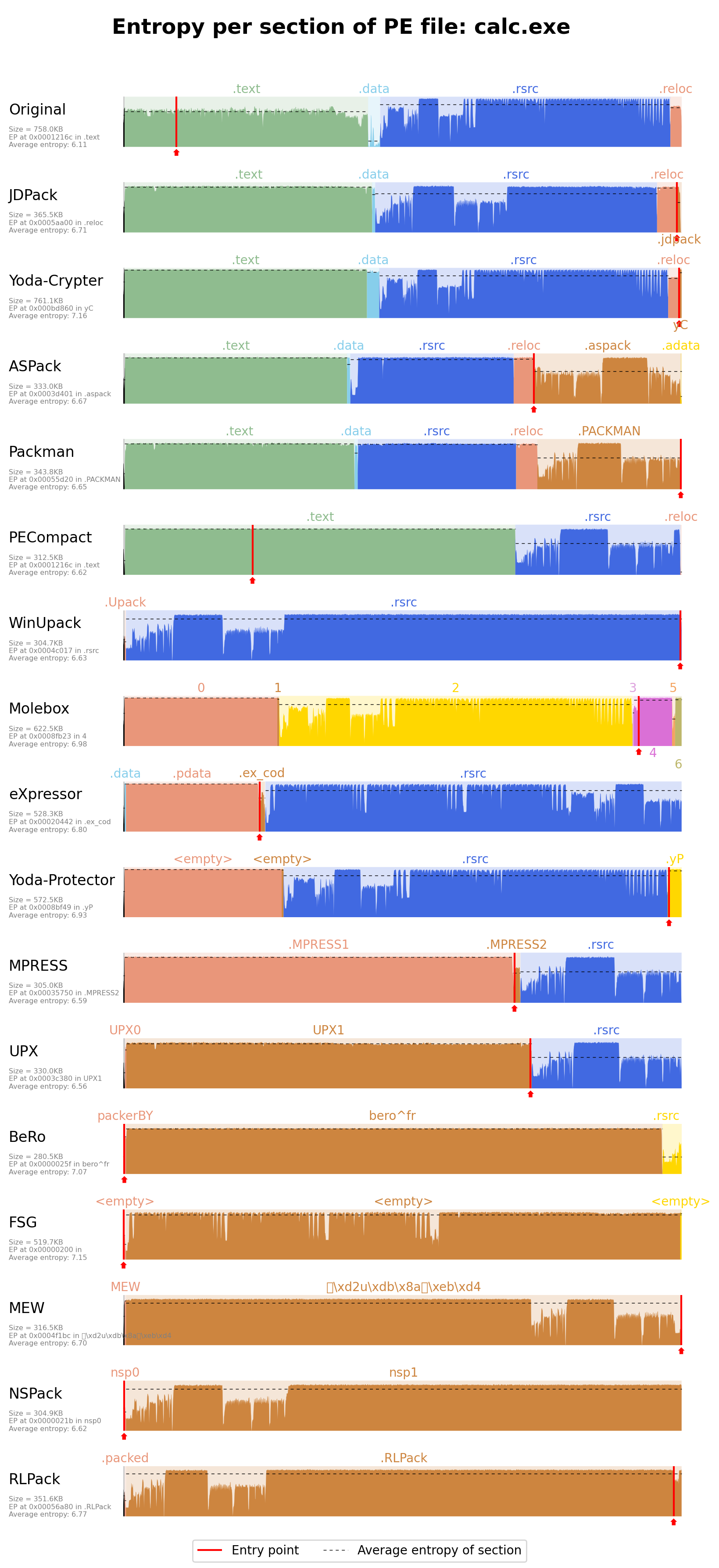
- Example ploting
calc.exeand its packed version (if exists)
This will result in a similar plot:
Compare
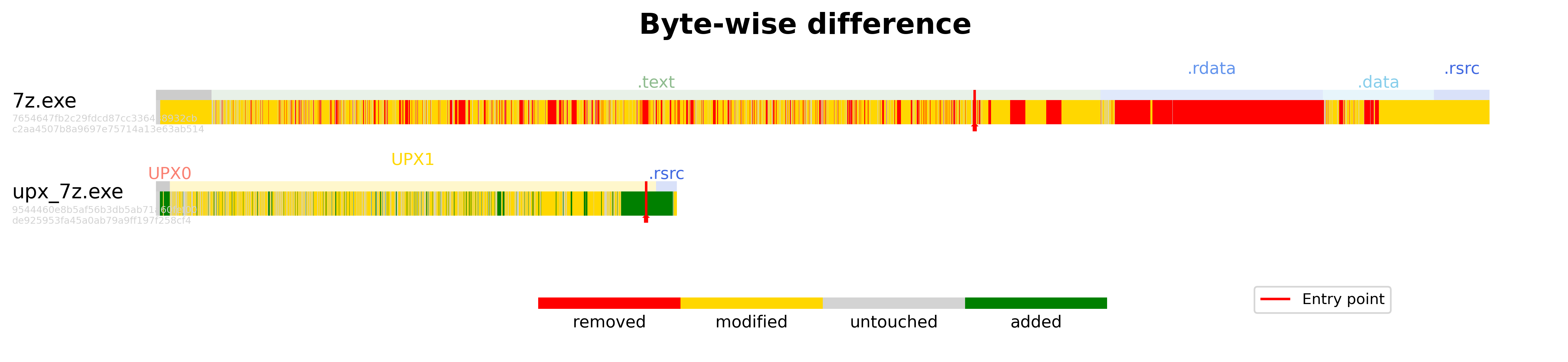
compare, takes two binaries and compares their contents. This command helps us to see exactly what has been changed in a binary between two versions.
┌──[user@packing-box]──[/mnt/share]────────
$ visualizer compare
usage: visualizer compare [-h] [--help] [-l1 LEGEND1] [-l2 LEGEND2] [-o FILE] [--text] [-t TITLE | --no-title]
                          pattern1 pattern2

visualizer compare: the following arguments are required: pattern1, pattern2
- Example of comparing two binaries:
This will result in a similar plot:
If the --text option is used, the output will be in text format:
--- /mnt/share/7z.exe

+++ /mnt/share/upx_7z.exe

@@ -33 +41 @@

-0xEE       0x2   NumberOfSections:              0x4
+0xEE       0x2   NumberOfSections:              0x3
@@ -47,6 +55,6 @@
SizeOfInitializedData:         0x1000
+0x10C      0xC   SizeOfUninitializedData:       0x10000
+0x110      0x10  AddressOfEntryPoint:           0x19920
+0x114      0x14  BaseOfCode:                    0x11000
+0x118      0x18  BaseOfData:                    0x1A000
@@ -55 +63 @@

-0x124      0x24  FileAlignment:                 0x1000
+0x124      0x24  FileAlignment:                 0x200
@@ -63,2 +71,2 @@

-0x138      0x38  SizeOfImage:                   0x18000
-0x13C      0x3C  SizeOfHeaders:                 0x1000
+0x138      0x38  SizeOfImage:                   0x1B000
+0x13C      0x3C  SizeOfHeaders:                 0x400
@@ -79,4 +87,4 @@
<<snipped>>
Features
┌──[user@packing-box]──[/mnt/share]────────
$ visualizer features
usage: visualizer features [-h] [--help] [-l [LABEL ...]] [-m MAX_NOT_MATCHING] [-r] filename folder

visualizer features: the following arguments are required: filename, folder
Find
This command is used to find in a dataset files matching a given pattern, and how many variations of the file, packed by distinct packers, are found within the dataset.
┌──[user@packing-box]──[/mnt/share]────────
$ visualizer find
usage: visualizer find [-h] [--help] [-l [LABEL ...]] [-m MAX_NOT_MATCHING] [-d] [-x [EXCLUDE ...]] filename folder

visualizer find: the following arguments are required: filename, folder
Example of finding all the files that are not packed in a dataset:
┌──[user@packing-box]──[/mnt/share]────────
$ visualizer find . datasets/dataset-packed-elf --no-display --max-not-matching 0

00:00:03.406 [INFO] Searching for files from datasets/dataset-packed-elf matching '.'...

00:00:09.298 [INFO] cntraining (7/7)
00:00:09.299 [INFO] file (7/7)
00:00:09.299 [INFO] flock (7/7)
00:00:09.299 [INFO] gdb (7/7) 00:00:09.300 [INFO] gsettings (7/7)
00:00:09.300 [INFO] killall (7/7)
00:00:09.300 [INFO] lynx (7/7)
<<snipped>>
-
Using the
--no-displayoption will not display which packers are found for each file. Instead it will only display the number of packers found for each file.7z.exe (1/25)means that 1 packer was found for the file7z.exeout of 25 packers in the dataset. -
Using the
--max-not-matchingoption will only display files that have less than the specified number of packers.--max-not-matching 0will only display files that are present in all packers datasets. (i.e. 25/25 packers found for the file)
Example of usage:
┌──[user@packing-box]──[/mnt/share]────────
$ visualizer find . dataset-packed-pe/packed --no-display --max-not-matching 2

00:00:00.240 [INFO] Searching for files from dataset-packed-pe/packed matching '.'...
00:00:04.132 [INFO] DarkNamer.exe (23/25)
00:00:04.132 [INFO] FastHash_kr.exe (23/25)
00:00:04.133 [INFO] Hash.exe (23/25)
00:00:04.133 [INFO] LoadOrd.exe (23/25)
00:00:04.133 [INFO] LoadOrdC.exe (23/25)
00:00:04.133 [INFO] OpenedFilesView.exe (24/25)
<<snipped>>